Monomers
Caustic Soda
Caustic Soda 50% LowPCF – certified product excellence
Caustic soda is an important base chemical for numerous applications. BASF has now a certified LowPCF variety that helps customers to offer even more sustainable products.
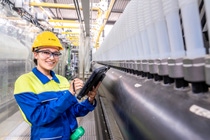

Continous Opex
Saving of CO2 emissions through operational excellence. We continuously invest in our Verbund sites to futher save CO2 emissions. Every measure counts and can make a big difference.
New Technologies
BASF is working on new technologies to replace fossil-generated steam and to use waste heat of its various production plants.
Grey-to-green
To cover our demand for renewable energy, we are pursuing a make-and-buy strategy. BASF’s share in the Hollandse Kust Zuid wind farm is one example of the “make” part of our strategy for securing renewable energy. But BASF is also delivering on the “buy” part in the form of power purchase agreements (PPAs) with ENGIE and Ørsted.
Benefit
for customers and environment

The PCF of our Caustic Soda 50% LowPCF is reduced by 1/3
- We contribute to Scope 3 emission reductions of our customers.
- Caustic Soda 50% LowPCF helps to reduce PCF of final product.
- Caustic Soda 50% LowPCF with certified PCF to claim sustainable raw material.
- Increased brand value and commitment to sustainability targets.
TÜV certification
Product carbon footprint of Caustic Soda 50% LowPCF certified by TÜV Rheinland
TÜV certification process according to ISO 14067:2018
- The methods used to carry out the study are consistent with the international standards.
- The methods used to carry out the study are scientifically and technically valid.
- The data used are appropriate and reasonable in relation to the goal of the study.
- The interpretations reflect the limitations identified and the goal of the study.
- The study report is transparent and consistent.

Good to know
Product Carbon Footprints
We have built an industry-leading system enabling us to provide product carbon footprints calculated with a certified digital solution.

1 Energy generation and chemical processes
2 BASF’s product carbon footprint (PCF) calculations follow the requirements and guidance given by ISO 14067:2018. In a methodology review, TÜV Rheinland has certified that the PCF methodology SCOTT developed and used by BASF SE for calculating the PCFs of BASF products is scientifically-based, is in accordance with ISO 14067:2018, and reflects the state of the art (ID-Nr. 0000080389: BASF SE - Certipedia).
3 ISO 14040:2006, 14044:2006, 14067:2018, GHG Protocol Product Standard
Membrane Cell Process
The consumption of electric energy is the lowest of the three processes and the amount of steam needed to concentrate the caustic is relatively low (less than one tonne per tonne of caustic soda)
The electricity consumption in membrane electrolysis can be significantly reduced by using renewable energy – this enables us to offer Caustic Soda 50% LowPCF.
